Crucially, this downturn also highlights the strategic importance of the UAE's strong bilateral economic ties with Egypt, which stands out as an anchor of stability in the region.
Regional divergence and the UAE's 2026 contraction
According to the International Monetary Fund’s (IMF) October 2026 Regional Economic Outlook: Middle East and Central Asia, released on Thursday, the economic fallout across the region has been intensely uneven.
While oil importers across MENAP have largely maintained resilience supported by robust remittances and stable tourism, oil exporters directly affected by shipping and energy disruptions, particularly those dependent on the Strait of Hormuz, have suffered steep downturns.
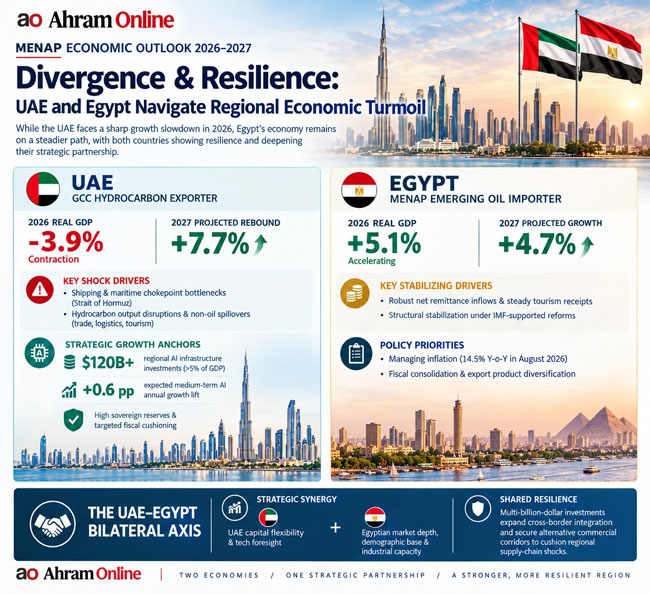
For the UAE, real GDP growth is projected to fall to -3.9 percent in 2026, a substantial downward revision from the earlier forecast of 3.1 percent. The contraction reflects disruptions to hydrocarbon production and supply chains, as well as spillover effects on non-oil sectors, including trade, logistics, and tourism. Hotel occupancy rates and flight arrivals also declined during periods of disruption.
Across the broader Gulf Cooperation Council (GCC), overall growth is expected to fall to -4.8 percent before a regional rebound kicks in.
A strategic anchor of shared resilience
This contrast between Gulf contractions and oil-importer resilience is most clearly illustrated by Egypt, whose deep-rooted partnership with the UAE provides mutual economic cushioning during times of crisis:
- Growth acceleration amid turbulence: Demonstrating notable macroeconomic stability, Egypt’s real GDP growth is projected to accelerate to 5.1 percent in 2026 (up from 4.4 percent in 2025) and hold steady at 4.7 percent in 2027, anchored by steady tourism and robust net remittance inflows.
- Bilateral synergy and logistics: The UAE’s multi-billion-dollar investments in Egyptian real estate, industrial infrastructure, and energy act as a vital strategic bridge. By expanding cross-border trade integration and securing alternative Mediterranean and Red Sea commercial corridors, the two countries effectively mitigate the maritime chokepoint risks emphasized by the IMF.
- Policy alignment: While Egypt manages domestic inflation, which reached 14.5 percent year-over-year in August 2026, following exchange-rate adjustments through IMF-supported structural reforms, close capital and investment flows from Abu Dhabi continue to reinforce Cairo's foreign exchange position and medium-term stability.
The 2027 rebound and strategic transformation
Looking ahead, the IMF's regional baseline projects a strong economic resurgence across MENAP, with growth bounding back to 6.6 percent in 2027 as trade and energy flows normalize.
In tandem, the UAE is poised for a recovery, with real GDP forecast to surge to 7.7 percent in 2027, propelled by the restoration of damaged supply routes and heightened hydrocarbon output capacity following the UAE's exit from OPEC+ production quotas.
Furthermore, the IMF emphasizes that the UAE is actively leveraging this period of disruption to fortify its long-term resilience alongside its regional partners:
- Artificial intelligence (AI) hub investments: Alongside Saudi Arabia and Qatar, the UAE announced massive AI-related infrastructure investments exceeding five percent of GDP (~$120 billion region-wide) in 2025. The IMF notes that AI adoption could lift medium-term annual growth across the UAE and the wider region by up to 0.6 percentage points, accelerating the transition away from traditional hydrocarbon dependence.
- Fiscal buffer deployment: Backed by substantial sovereign wealth reserves, the UAE deployed targeted fiscal and financial accommodations to preserve credit flows and safeguard local businesses against immediate conflict shocks.
Together, the UAE's forward-looking technology investments and Egypt's ongoing structural reforms demonstrate how strong regional partnerships and strategic diversification can effectively navigate even the most challenging geopolitical environments.
The economic realities underscored by the IMF's October 2026 report highlight a vital takeaway: while regional conflicts generate severe, asymmetrical shocks that force key energy exporters like the UAE into temporary contractions, oil importers like Egypt maintain positive momentum; isolated national buffers are no longer enough on their own.
The convergence of the UAE’s forward-looking technology investments and Egypt’s structural stabilization agenda demonstrates that sustainable recovery relies on deep bilateral integration and mutual support.
By pairing Abu Dhabi's capital flexibility and digital-economy foresight with Cairo's demographic strength, industrial depth, and reform-backed resilience, the UAE-Egypt axis proves that strategic partnerships and diversification are the ultimate shields against systemic regional uncertainty.
Short link: